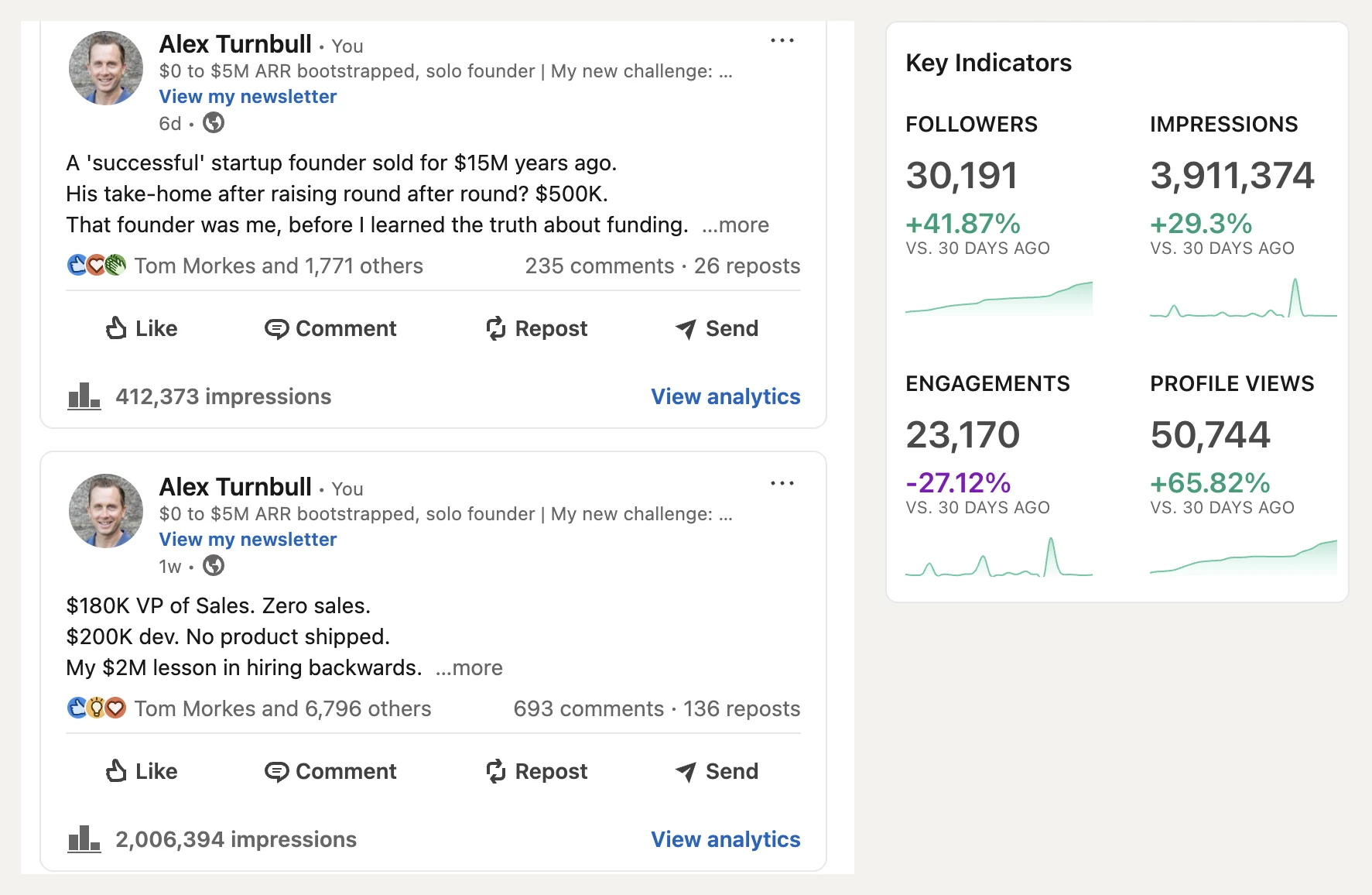
I took Helply's beta from $0 to $1M ARR in 7 months.
LinkedIn was my only channel. Now you can use the same GTM platform I built. Give it your offer or idea, plus your materials. It builds your positioning, rebuilds your LinkedIn profile to A+ standard, and runs your campaigns. The DM Copilot drafts every DM in real time, and the analyst agent tells you how to run your campaign tests and what to change.
(Oh yeah, and my ghostwriters write your posts every week too. They took me from 0 to 70K followers and 70M impressions in just under two years.)

Alex Turnbull
Founder of Helply. Bootstrapped Groove to $5M ARR. Message me on LinkedIn
- unchecked volume need · deal size · who owns sales
- quoted “kind of random” = pain stated · “burned some cash” = has spend
- not-fit risk wants steadier work, not more work
- ledger nothing spent · bank: agency result for the pitch
M-VALUE · M-Q- names a number → test it against his pipeline
- says “depends” → Choice Scaffold: 2? 5? Or what
- asks about the playbook → Sauce Drop, then the question again
What LinkedIn did for me
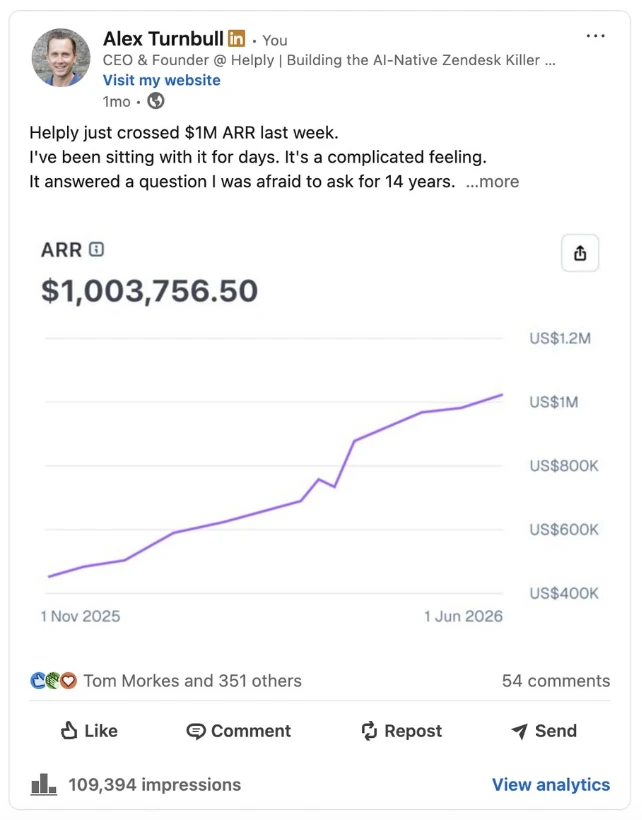
I started on LinkedIn with zero followers. This is the same system that built my brand and booked my sales calls.
Why I am opening my platform
My team and I built this platform for my own LinkedIn. It cost more than $500,000 to build.
It builds my offer, profile, and lead lists. It runs my campaigns, sends my connection request, drafts each DM, and handles conversations in real time. It analyzes every result and tell me what to do and test next. And my ghostwriters write my posts.
In First Degree Academy, I teach founders to build each part by hand. Many founders do not want to build it. They want to use it, plug and play. So I am opening 5 spots on my platform. My team sets it up with you in one week, shows you how to operate it, and are available to support you.
AlexAlex Turnbull, founder of Helply
How the system books calls
The system has three parts. Each part feeds the next. The analyst measures all three and finds what to improve.
Gravity: your posts
You post five times a week. My ghostwriters write each post for you. ICP aligned people see the posts, look at your profile, and engage.
Signals: your campaigns
The platform sends connection requests every day. It starts with the warmest people:
- People who engage with your posts
- People who engage with your competitors' posts
- Active buyers from auto refilling lead list campaigns
Conversations: your DMs
When a person replies, the Copilot tells you what to send next. Each message moves the conversation toward a booked call.
DFY gives you the finished platform
First Degree Academy teaches you to build each part of the system by hand, in Claude. First Degree DFY gives you the finished platform. You do not build anything. You just function as the operator with our support.
First Degree Academy
You build the system by hand
- You build your offer and your profile, one prompt at a time
- You build and refresh your lead list each week
- You write each DM yourself
- You fill in your tracker and read it
- You write your own posts
First Degree DFY
You operate the finished platform
- The Offer Architect builds your offer and rebuilds your profile
- The list builder builds your lists and runs your campaigns
- The Copilot drafts each message in real time
- The data tracker fills itself, and the analyst finds what to improve
- My ghostwriters write five posts a week for you
From setup to booked calls
My team sets up the platform with you in one week. Then you run these six steps. You can change anything at any step.
-
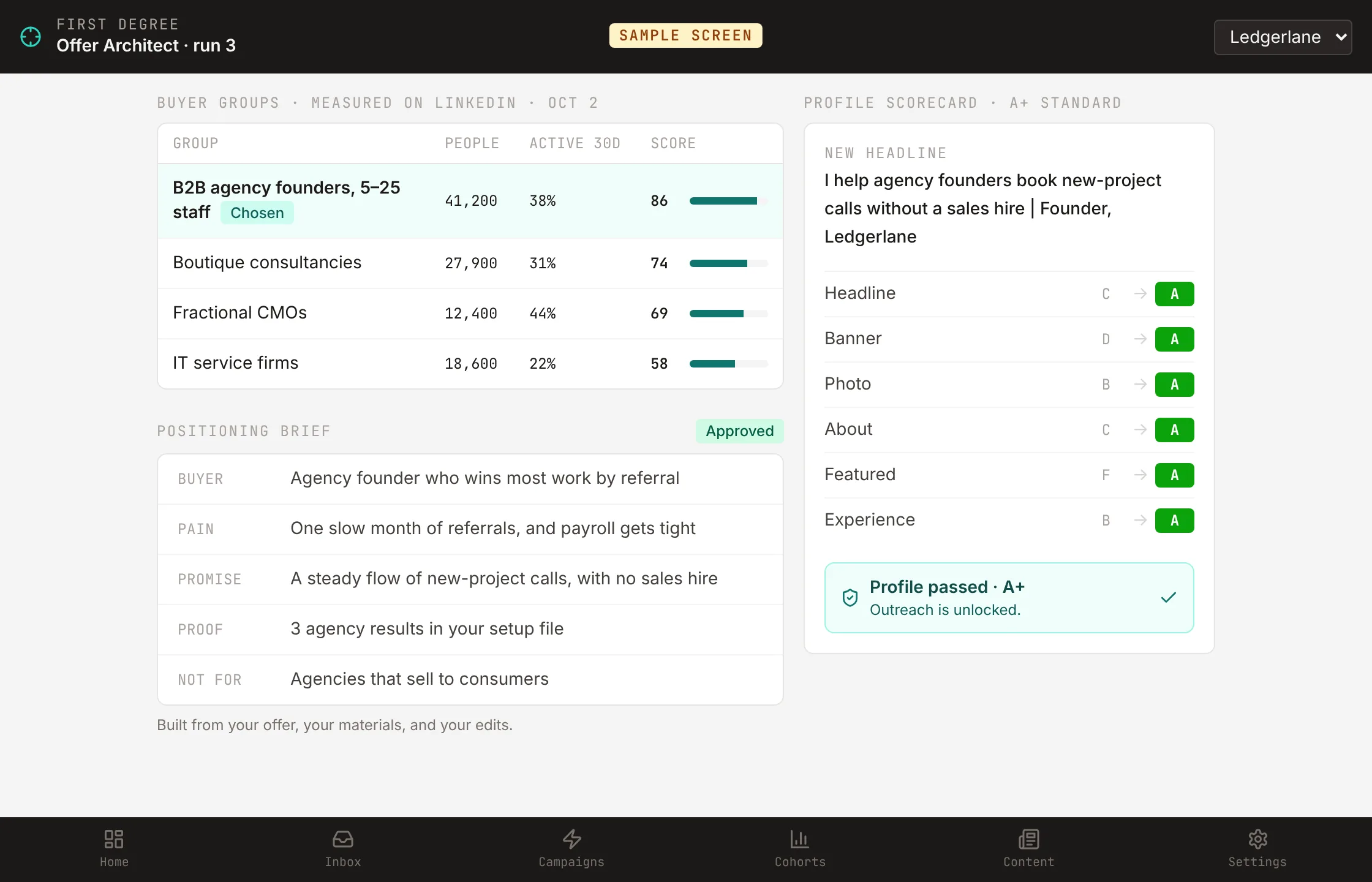
Build your offer and your profile
Give the Offer Architect your offer or idea, plus your materials. It measures each possible buyer group on LinkedIn and ranks them. Then it writes your positioning. Next, it rebuilds your LinkedIn profile to A+ standard: headline, banner, photo, About, Featured, and Experience. It grades each section, and outreach starts only after your profile passes.
You: your materials and your decisions
-
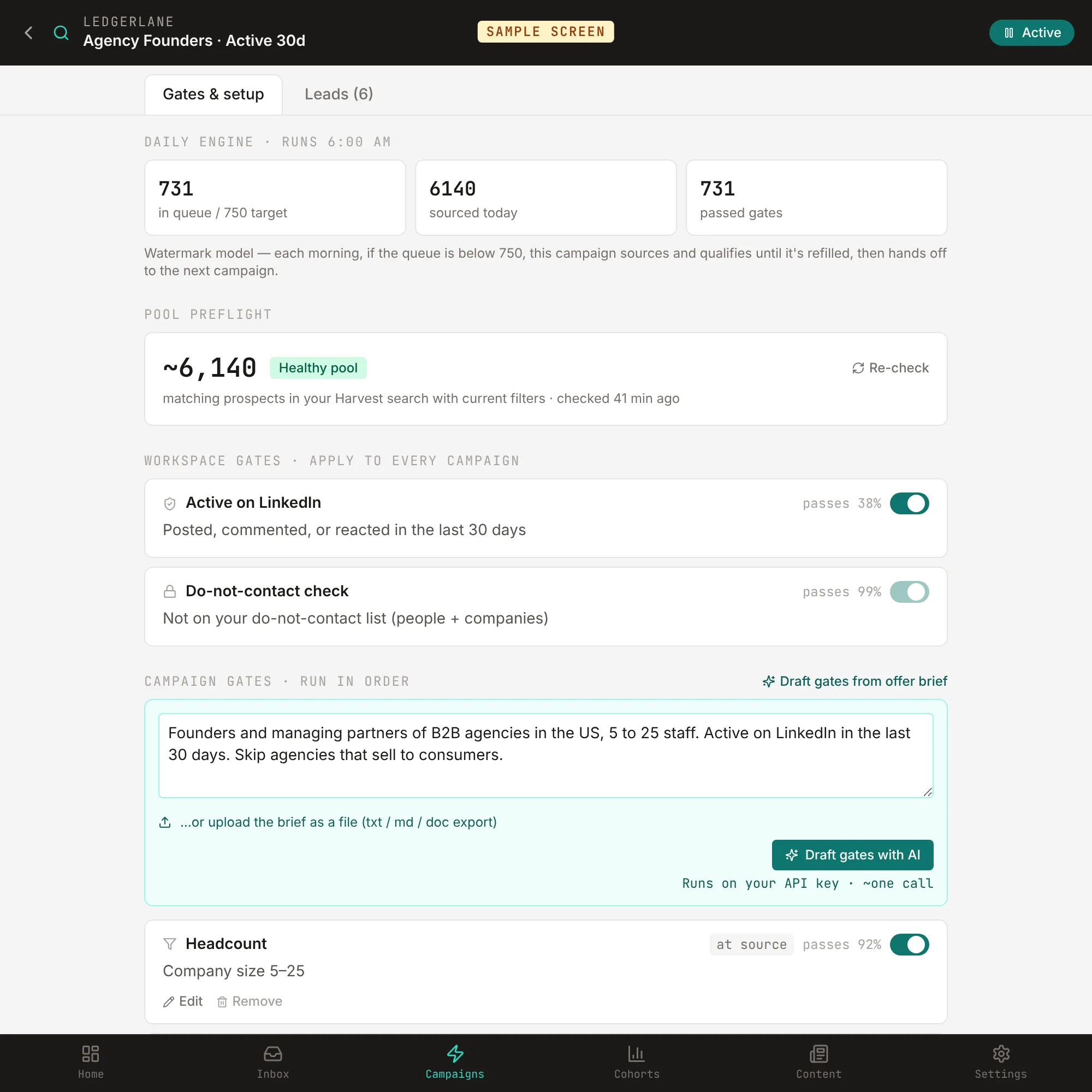
Build your lead list
Write a short brief. The list builder turns the brief into a search and pulls the people with your Harvest API key. It scores each person against your buyer and keeps only people active on LinkedIn in the last 30 days. You see each stage, and you can change it.
You: the brief and your Harvest API key
-
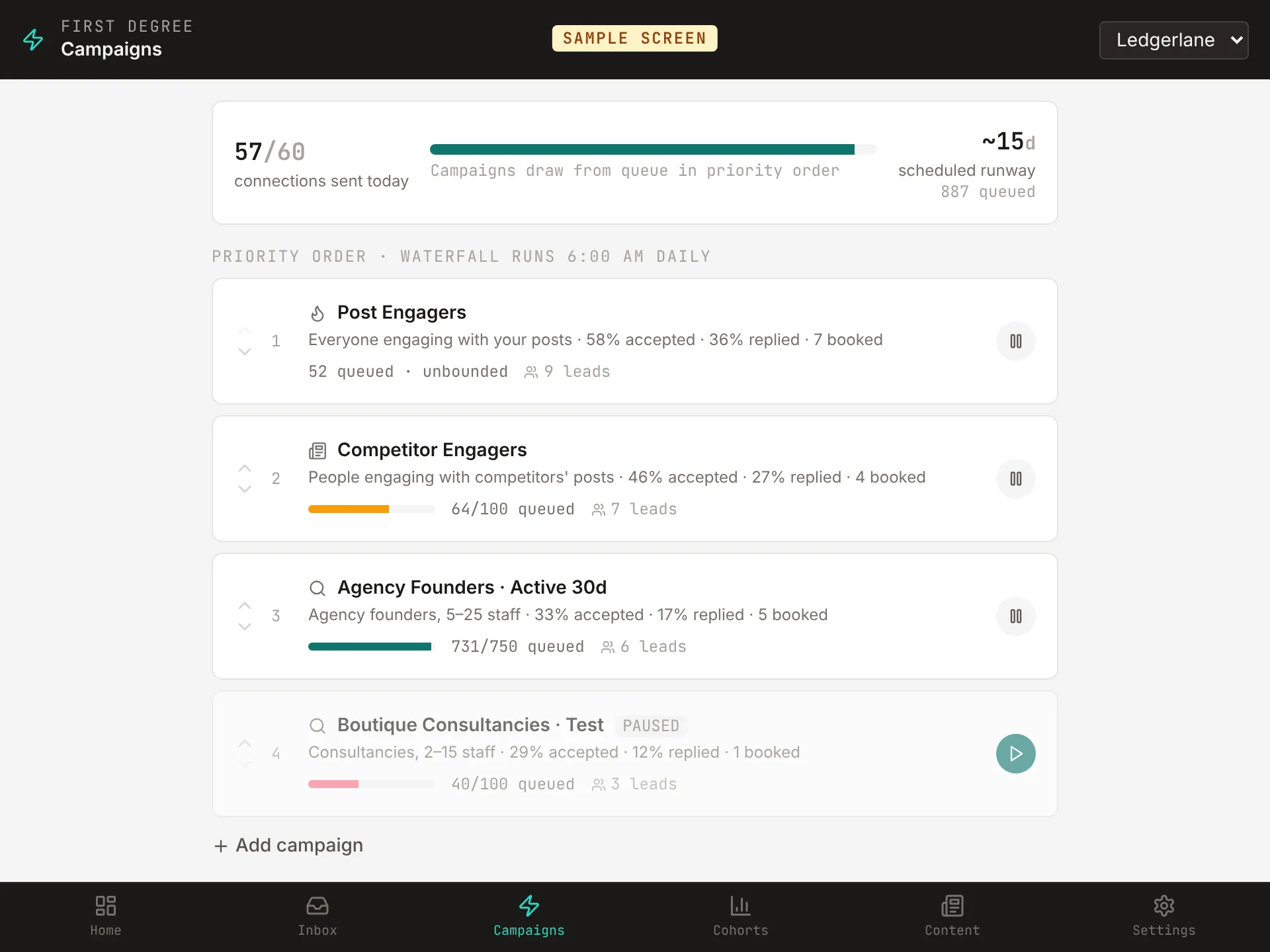
Launch your campaigns
Your campaigns send connection requests from your account every day, at a human pace. The system is built to keep your account safe from any kind LI restrictions.
You: approve the launch
-
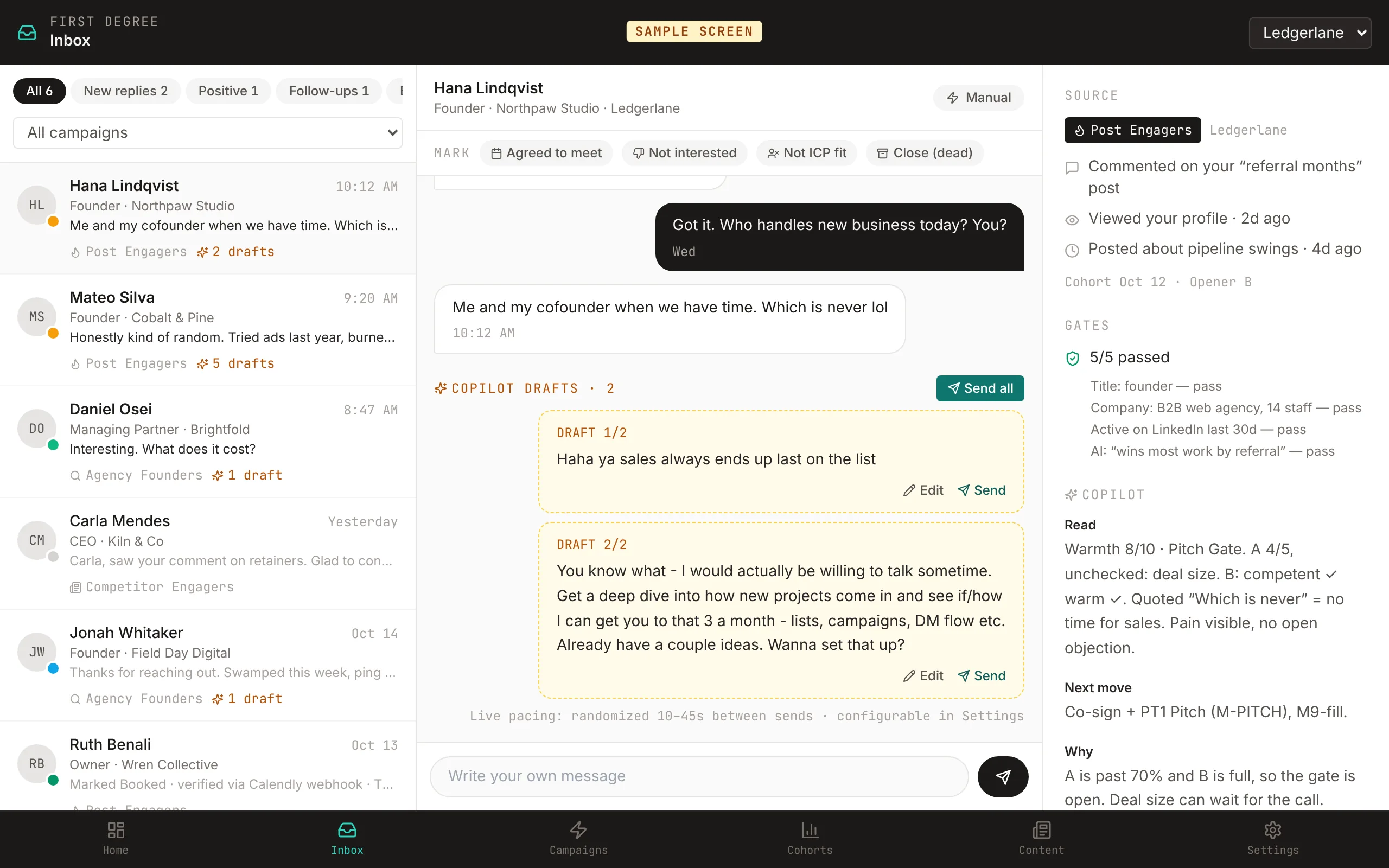
Answer each reply with the Copilot
Accepted connections go straight to your inbox. For each reply in a DM or InMail, the Copilot reads the conversation and the prospect's profile. It reads the board, picks the move, and writes the messages. It tells you why, and what to do for each likely reply. You edit the tone and send.
You: edit and send
-
Improve the system with the analyst
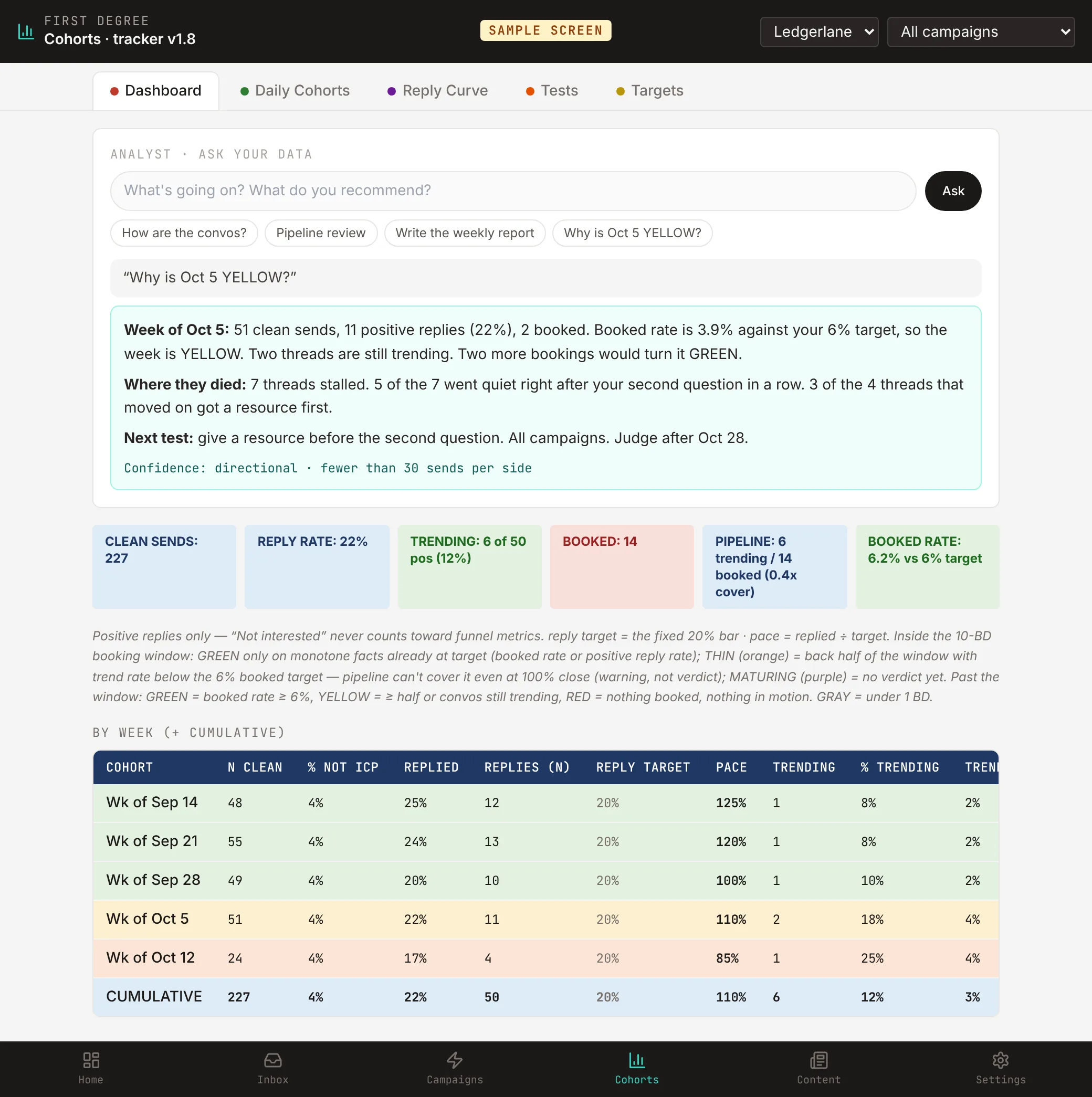
The tracker records each step, from accepted request to booked call and all of the variables pertaining to your offer and test variants being ran. The analyst reads all of it. Each campaign, test, and conversation. It finds the change that will add the most booked calls. Then it helps you set up the test and judge it.
You: approve each test
-
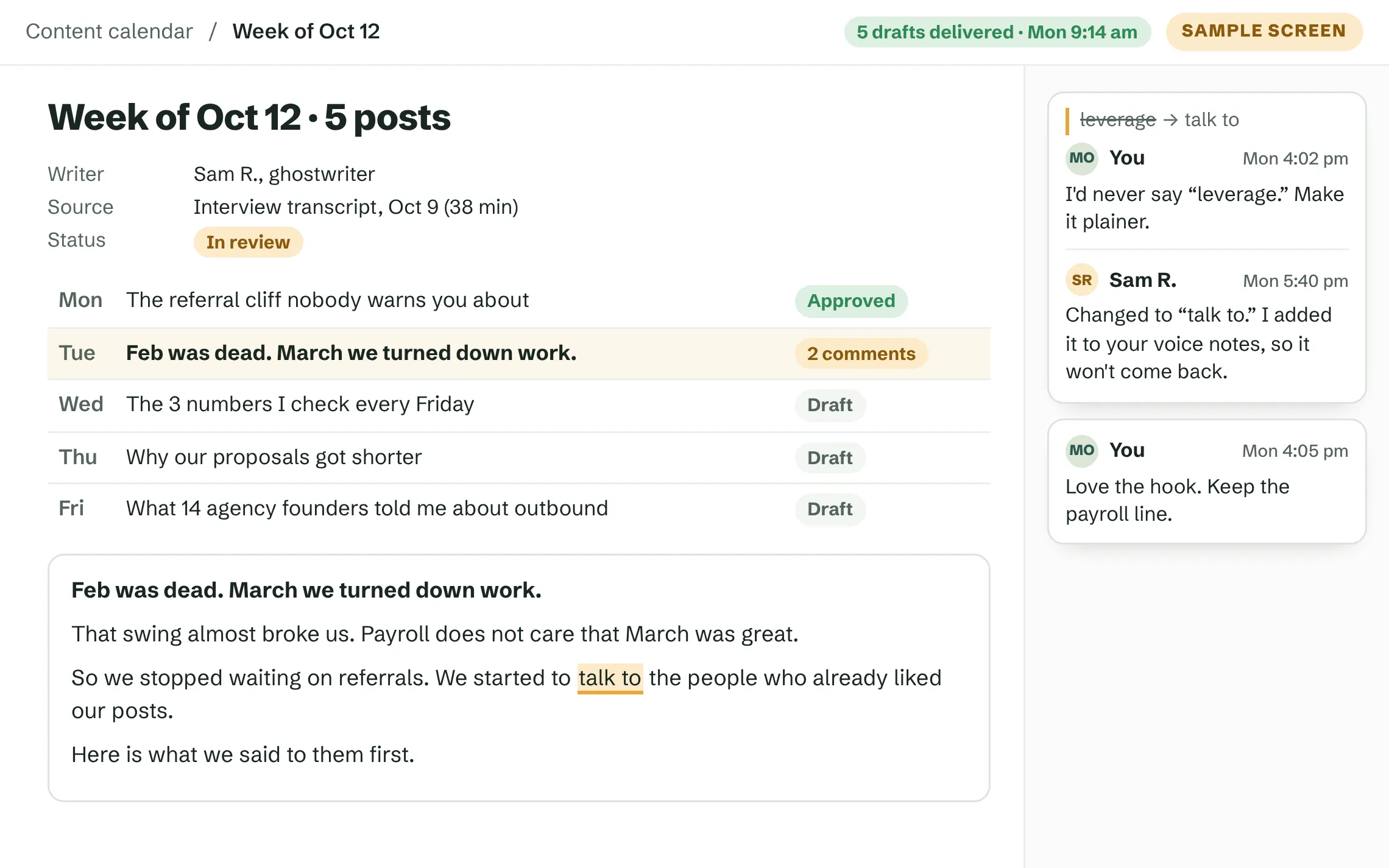
Get your posts written
An agent interviews you, and you send the transcript. My ghostwriters write five posts a week from it for you. The drafts arrive within 72 hours.
You: the interview and your review
What the Copilot does
The Copilot plays each conversation the way a chess engine plays a game. Each new message changes the position. On every turn a decision tree picks the move, and an the co-pilot writes the messages.
Meter A: your clarity
Are you 70 to 80% sure that a call makes sense for this person? The Copilot keeps a fit checklist for your offer. Each box starts unchecked. Only a fact that the prospect states can check a box.
Meter B: their belief
Does the prospect believe that you are competent and that you can help? Do they trust you not to pitch what they do not need? Each turn must move at least one meter. The best turns move both.
Seven steps, every turn
- Read the boardIt scores warmth from 0 to 10. Each reply is an opportunity to move the score. A ledger tracks what you shared, what pain they stated, and what is still open.
- Find the phaseBridge, Clarity Loop, Pitch Gate, Link Ritual, Confirmation, or Follow-up. Each phase allows only certain moves. An objection at any point overrides the phase.
- Test the fitIt names the strongest reason this person may not be a fit. If that reason is still open, subsequent moves test it.
- Pick the moveIt picks from eight menus of moves trained off of thousands of DM conversations that resulted in qualified booked calls. Bridges, questions, value, proof, threads, pitches, objections, and follow-ups. It asks one question per turn, at most. It pitches only when both meters clear the gate.
- Write in your voiceThe voice rules are measured from real B2B sales conversations on LinkedIn. A typical message has 6 words. Pitches and other high-stakes lines start from proven sentence patterns, not free writing.
- Check the draftA critic assumes that the draft fails and looks for the fault. It runs eight checks, including truth, one question per turn, and a list of hard blunders. Any fail means a redraft.
- Show you the turnYou get the read of the copilot's board (the conversation to that point), the move, the messages to send, and the logic behind the decisions. You also get a plan for each likely reply, and the questions left before the pitch.
It never invents a fact
Proof, results, names, and resources come only from your setup file. If a fact is missing, the Copilot plays a move that does not need it. Then it tells you what the gap may cost you.
Each follow-up brings something new of value. It never says "just checking in." A clear no stops the follow-ups.
You stay in control
The Copilot recommends, and you decide. Edit each draft so it sounds like you, then press send. After about 100 edited messages we update the voice rule with those RFL pairs so your copilot sounds like you. Use auto mode only after the drafts sound like you.
Helply's beta hit $1M ARR on version 1 of the Copilot. You get the current version (Version 6.8).
- You edit the drafts
- The platform records your edits
- Your voice settings update
- You make fewer edits each week
- You turn on auto mode when you are ready
What the analyst does
The platform records all data across you LI GTM motion. Including requests sent, accepted, replied, booked, all DM conversations and each test variant you run. The analyst reads all of it and guides you on what should happen next across your campaigns.
- It grades every cohortEach day and each week of sends is a cohort. The analyst grades each cohort against your targets for reply rate, booked rate, and booking window. Each cohort gets a health color: GREEN, YELLOW, RED, or THIN. It shows what will change the color, and by when.
- It finds where conversations dieFor each stalled thread, it analyzes the conversations. Then it compares your stalls with a dataset of thousands of B2B conversations that booked a call. That shows the exact point where your threads break from established patterns and how to fix it.
- It runs clean testsEach test changes one thing. The analyst compares tests at the same age and judges them after the booking window.
- It credits every bookingEach thread carries its list source, opener variant, and test. So the analyst shows which list, opener, resource, and move book the most calls.
- It audits your messagesIt checks every message you sent against the Copilot's rules and your offer's guardrails. It quotes each break and counts the breaks by rule and by test.
- It separates list problems from message problemsLeads outside your buyer profile stay out of every clean number. If their share goes up, the problem is your list hygiene.
Each answer ends with one change to test. It names the variant, the scope, the change, the reasosn, and the judge date.
The result
Follow the process that First Degree lays out, and do the work every week. You will book 2 to 5+ sales calls a week. You will also build a founder-led brand that scales your SaaS product, PLG or sales-led. Same approach I'm using with Helply.
Week of Oct 5: 51 clean sends, 11 positive replies (22%), 2 booked. Health: YELLOW. Two threads are still trending, so the color can still change.
Where they died: 7 threads stalled. 5 of the 7 went quiet right after your second question in a row. 3 of the 4 threads that moved on got a resource first.
Benchmark: in the booked-call dataset, threads at this point usually get a resource before a second question.
Exception: Lumen Studio took two questions and still booked. That thread started warm, from your post.
Confidence: directional. Each side has fewer than 30 sends.
Next test: give a resource before the second question. Scope: all campaigns. Judge after Oct 28.
My ghostwriters write your posts
My ghostwriters took me from 0 to 70K followers and 70M impressions in just under two years. The same ghostwriters write your posts.
- Get interviewedAn agent interviews you remotely.
- Send the transcriptPut it in your inbox folder, or send it on Slack.
- Get your postsMy ghostwriters write five posts a week in your voice.Drafts within 72 hours
- ReviseThe writer does one revision pass per batch, or you revise the posts yourself. Comment in Notion, and the ghostwriters learn your voice.
One plan
$2,000 / month
All in. Five posts a week included. Set up in one week.
Apply for a spot5 spots. You need a LinkedIn account, an Anthropic account and API key, a Harvest API key, and a Calendly subscription.
What this costs to hire
First Degree DFY: $2,000 a month.
Questions before you apply?
Message me on LinkedIn.
- Setup and trainingMy team sets up the platform with you in one week. We show you how to operate each part.
- The Offer Architect and profile rebuildYour offer and positioning, then your LinkedIn profile rebuilt to A+ standard.
- The list builder and campaignsScored lists of active buyers, and connection requests every day.
- The Copilot and inboxThe board read, the move, the messages, and the plan, for each conversation.
- The tracker and analystEach number from accepted request to booked call, and the next change to test.
- Ghostwriting, five posts a weekInterviews, drafts within 72 hours, and one revision pass per batch.
Who this is for
The platform works when these three things are true.
- You sell B2B.Your buyers are businesses, not consumers.
- Your buyers are white-collar.They are professionals who use LinkedIn for work.
- 5,000 or more of your buyers were active on LinkedIn in the last 30 days.They could use your product or your services. You do not need a product yet. You need to know the problem you solve, and you want users or clients fast. The Offer Architect measures this number for you.
Sales-led offers fit best, because a booked call is how you win a customer. Product-led (PLG) products need LinkedIn too. For a PLG product, a founder-led brand and good DMs matter even more.
Apply in one sentence
5 spots. Apply, then book a call with us to get started.
- Today
Send one sentence. Tell us your name, what you sell, and who buys it.
- Next
Book your call. Right after you apply, you pick a time.
- Within one week
Your platform is ready. My team sets it up with you and shows you how to run it.
- Every week after
You run the system. Five posts go out, the Copilot helps with each reply, and the analyst finds the next change to test.
Questions
Do you run it for me?
No. You run it. My team sets up the platform with you, shows you how to operate it, and is available to support you. After that, you make the decisions, edit the messages, and press send. My ghostwriters write your posts.
How fast can I start?
My team sets up your platform within one week. Then you launch your first campaign, and your posts start to go out.
Does the Copilot send messages for me?
Only in auto mode. Edit and send each message yourself until the drafts sound like you.
What if I do not have a product yet?
You can still apply. You need to know the problem you solve, and 5,000 or more of your buyers must be active on LinkedIn.
What do I need?
Four accounts: your LinkedIn account, an Anthropic account with an API key, a Harvest API key for your lead lists, and a Calendly subscription for bookings. You also need to set aside time for your content interviews.
Who writes my posts?
The ghostwriters who write my posts. They write from your interview, in your voice. Drafts arrive within 72 hours.
How is this different from First Degree Academy?
First Degree Academy teaches you to build each part by hand, operate it manually, and run it yourself from Claude. First Degree DFY gives you the finished platform completely automated, with the Copilot, the analyst, and my ghostwriters.